BUSINESS INSIGHTS FOR UK SAVVY SMALL BUSINESSES

BUSCOO.PRO BUSINESS INSIGHTS / SAVVY INSIGHTS FOR UK HOME-SERVICE TRADE BUSINESSES
How UK Trade Businesses Get Leads...
and What Actually Works, and What Doesn't
Before you buy another lead, make more of the ones you already get.
From word of mouth, local ads, bought leads to paid clicks - what earns its keep & how to join it all together.
BUSCOO.Pro
October 2026
The complete guide
THE QUESTION BEHIND EVERY ENQUIRY
You can pay to get their attention.
You still have to win their business.
A sign. A search. A recommendation. They all start a journey.
What happens next decides whether it turns into work.
BUSCOO.PRO BUSINESS INSIGHTS / SAVVY INSIGHTS FOR UK HOME-SERVICE TRADE BUSINESSES
START HERE
More marketing.
Or more from your marketing?
Your name is on the van. You've paid for an advert. Someone has recommended you. Perhaps you're paying for Google clicks or buying leads as well.
So why does keeping the diary full still feel like such hard work?
Because getting someone interested and getting the job are two different things.
The advert gets noticed. The customer looks you up. They check your work, read a few reviews and decide whether to get in touch.
Then someone needs to answer, understand what they want, arrange the next step and follow through.
You can pay to get their attention. You still have to win their business.
That's where opportunities can slip away—and where a better-connected business can make more of the money it already spends.
This guide looks at the main ways UK trade businesses attract work: what each does well, where it struggles and what needs to happen afterwards.
Because a flyer, a referral, a Google advert and a roadside sign can all work. The real question is whether they work together.
WHAT WORKS
THE LIMITS
SPEED
RELATIONSHIP
MEASUREMENT
VALUE

EXISTING CUSTOMERS
Existing customers: the next job could already be in your phone
Think about everyone you've worked for over the last few years.
They know your name. They've seen your work. If you did a good job, you've already cleared one of the biggest hurdles: trust.
Yet how many hear from you again?
A plumber who fitted a bathroom could help with the kitchen. An electrician who replaced a consumer unit could install outdoor lighting or an EV charger.
A driveway customer might not need another driveway for years, but could need maintenance—or know someone planning one.
The opportunity isn't to bombard them with offers. It's to remain useful and easy to remember when another need comes along.
What works well
Relevant service reminders, thoughtful follow-up and letting customers know about other work you do. You start with an established relationship rather than a cold introduction.
Where it struggles
Old contact details, incomplete records and messages that have nothing to do with what the customer needs. Repeat demand also varies enormously by trade.
How quickly
A relevant conversation can produce an enquiry straight away. Other opportunities follow the customer's maintenance or project timetable.
Who holds the relationship
You have the direct customer relationship, provided their details and history are held in records you can access and use appropriately.
Can you measure it
Yes. Record the outreach, replies, quotes and booked work against the customer.
When spending stops
The relationship remains. But if you disappear from view, someone else may be the name they remember next time.
The BUSCOO connection
Keep the customer history, next action and relevant reminders connected, so repeat work doesn't depend entirely on your memory.

RECOMMENDATIONS
Recommendations and referrals: give good word of mouth a helping hand
“Most of our work comes through recommendations.”
That's a strong position. It means people are willing to put their name behind yours.
But there's a difference between earning recommendations and making them easy to pass on.
Your customer may be delighted with the job. Their neighbour may be considering something similar. Neither necessarily thinks to make the introduction at the right moment.
A friendly request, an easy-to-share link and a useful follow-up can turn “I'll mention you” into an actual conversation.
What works well
Trust travels with the introduction. The prospect has a reason to consider you before you've said a word.
Where it struggles
Referrals can be unpredictable. A glowing recommendation can also lose its momentum if the prospect finds an unconvincing website or cannot get a response.
How quickly
Immediately when somebody has a live need; otherwise it builds over time.
Who holds the relationship
You, once the introduction becomes a direct conversation and you capture the details.
Can you measure it
Yes—ask who recommended you and record the resulting work. Informal word of mouth will never be perfectly traceable.
When spending stops
Customers can keep recommending you. Stopping the prompts and follow-up means you rely more heavily on chance.
The BUSCOO connection
Make sharing easy, capture where the introduction came from and give the referred customer a clear next step.

VANS & SITE BOARDS
Vehicle signage and site boards: let the work advertise the business
A van outside a house tells the neighbours somebody nearby has chosen you. A board beside a completed driveway puts your name next to work they can see for themselves.
That's a useful combination: local visibility and visible evidence.
But people rarely stand beside your van carefully copying down every service you offer. They need to understand what you do and remember how to find you.
A sign has seconds to earn the next step. Let the website do the explaining.
What works well
Repeated local exposure and recognition, particularly around current jobs and finished work.
Where it struggles
Cluttered designs, unreadable contact details and no clear service or location. Exposure also depends on where the vehicle or board actually appears.
How quickly
It can generate enquiries as soon as it's visible. Familiarity builds with repetition.
Who holds the relationship
You, when the person contacts your business directly.
Can you measure it
Partly. Ask how they found you and use a memorable campaign address or suitable tracking number. A QR code can help on a board people can safely approach; a moving vehicle needs readable information.
When spending stops
Existing signage can keep working while it stays visible and relevant, without buying every new impression.
The BUSCOO connection
Make sure the business people find online matches the confidence your vehicle and work created in the street.

ROADSIDE ADVERTISING
Roundabout and roadside advertising: seen today, searched for later
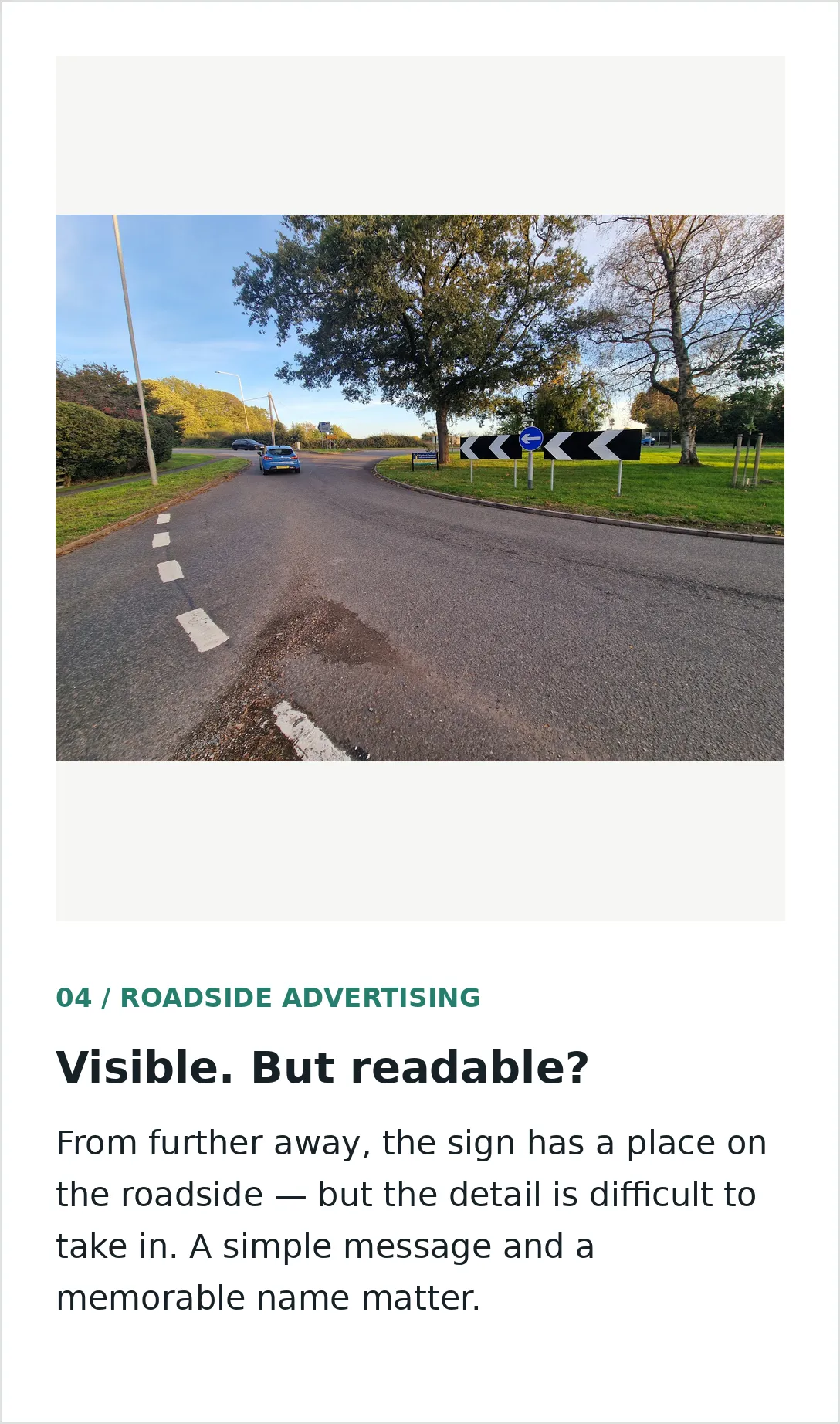
EXAMPLE: LOCAL ROADSIDE SIGN
JUNCTION VIEW
EXAMPLE: LOCAL LEGAL ROADSIDE SIGN
CLOSER VIEW
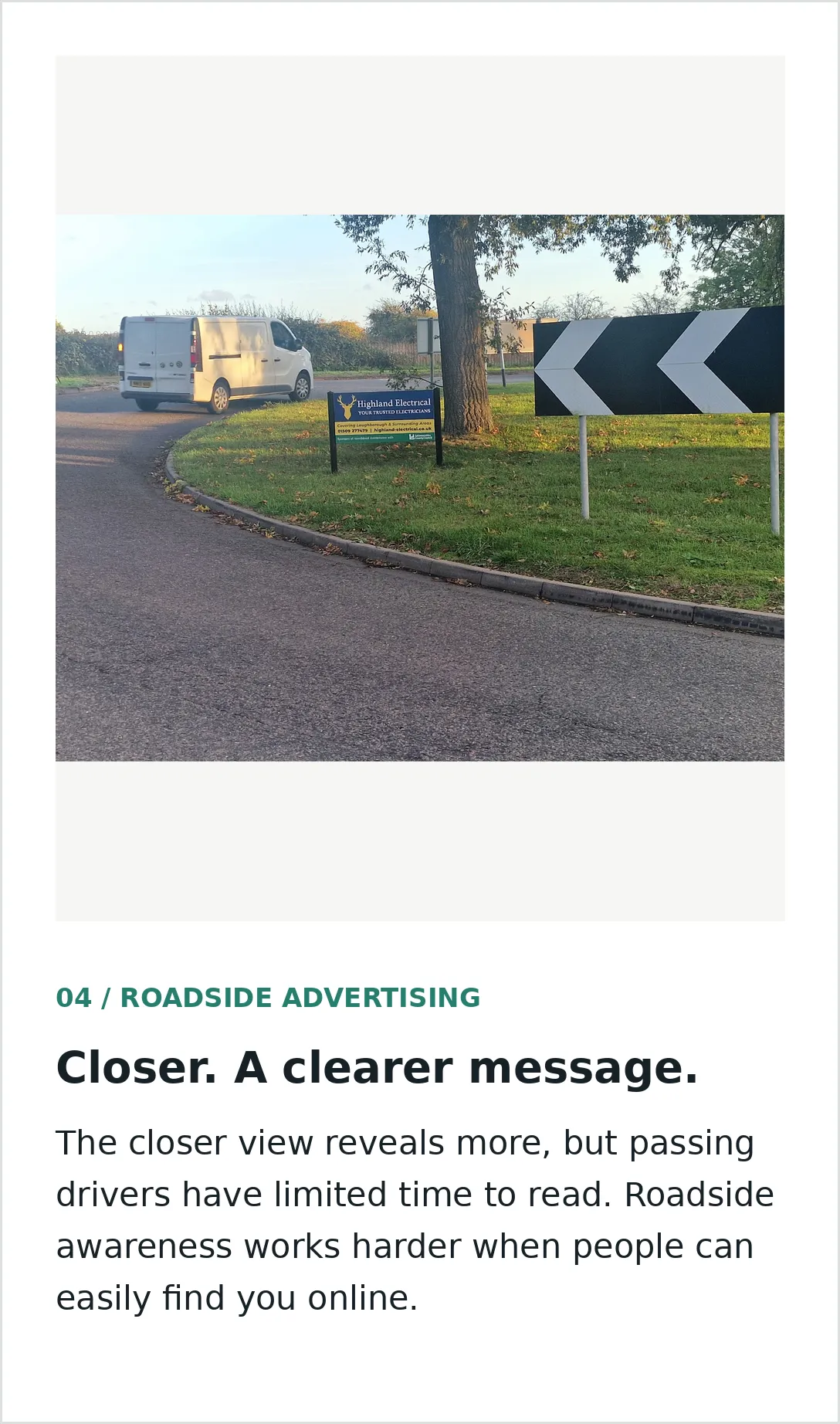
PLEASE NOTE: These are Not BUSCOO designs - They are real life examples of 3rd party print adverts
You may pass the same local business name every morning without needing its services.
Then something changes. The lights start tripping. You're planning an extension. The driveway finally needs replacing.
That familiar name has a head start.
Roundabout advertising and roadside signs can create precisely that kind of recognition. They do not have to generate an immediate phone call to play a useful part.
But recognition needs somewhere to go. If the customer searches for the name later, what will they find?
A sign has seconds to earn the next step. Let the website do the explaining.
What works well
Brand Awarness:
Repeated visibility in a defined local area and a simple message people can remember.
Where it struggles
Most passers-by aren't looking to buy at that moment. Location, readability and the match between the audience and service matter. Counting traffic is not the same as counting customers.
How quickly
A person with an immediate need may respond quickly; wider recognition generally takes repeated exposure.
Who holds the relationship
You, after a direct enquiry. The advertising location itself holds no customer relationship for you.
Can you measure it
Partly, through dedicated contact routes and asking customers. Someone who saw the sign and later searched Google may simply tell you “Google”.
When spending stops
Paid exposure ends when the placement ends. Some recognition may linger, and relationships already won can continue.
The BUSCOO connection
Join the street-level impression to the online proof and a responsive contact route.

FLYERS & LOCAL PRINT
Flyers, newspapers and local magazines: something tangible, close to home
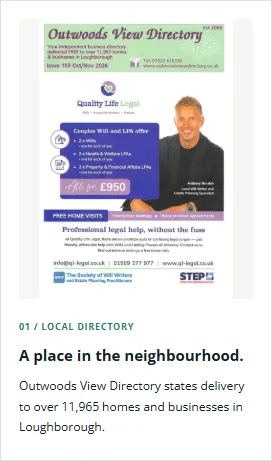
EXAMPLE: LOCAL DIRECTORY
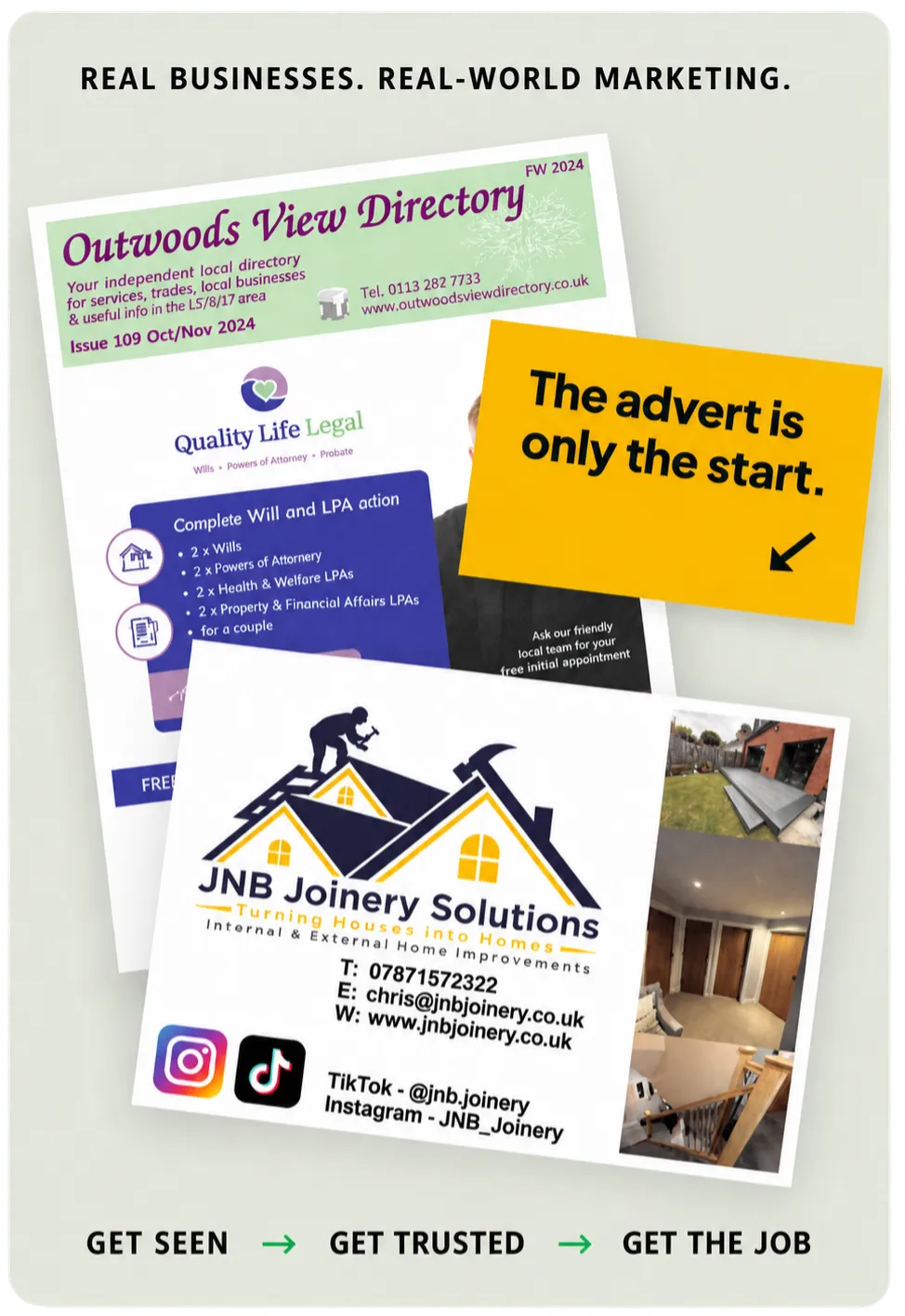
EXAMPLE: LOCAL DOOR FLYER
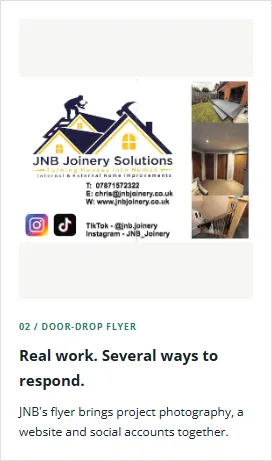
PLEASE NOTE: These are Not BUSCOO designs - They are real life examples of 3rd party print adverts
A well-timed leaflet can arrive just as someone is thinking about a project. A community publication can put your business into homes in the area you want to serve.
Print still has a practical role. People can keep it, share it and return to it.
The weak point is often the message. A logo, a long list of services and “quality work at competitive prices” give the reader little reason to choose one business over another.
Show the work. Make the benefit clear. Give them a reason to take the next step.
A sign has seconds to earn the next step. Let the website do the explaining.
What works well
Reaching selected neighbourhoods, supporting a local reputation and making a specific offer visible outside digital channels.
Where it struggles
Poor targeting, forgettable creative, weak timing and judging a campaign only by the number of items delivered.
How quickly
Responses can arrive during distribution or publication, with later enquiries from copies people keep. Some campaigns produce little response.
Who holds the relationship
You, when the reader responds directly.
Can you measure it
Yes, partly: dedicated landing pages, QR codes, contact numbers and source questions help connect responses to jobs.
When spending stops
New distribution stops. Existing copies can continue producing a tail of enquiries, but that exposure fades.
The BUSCOO connection
Join the street-level impression to the online proof and a responsive contact route.

Google, websites & reviews
Google, websites and reviews: where interest becomes confidence
Someone hears your name. Sees your van. Reads your advert. Receives a recommendation.
What happens next?
They may look you up.
This is why your digital presence matters even when you say, “We don't get our work from the internet.” The internet can be where a customer decides whether to act on a recommendation they received somewhere else.
Your Google presence helps people discover and check the business. Reviews let previous customers speak. Your website gives you room to show what you do, explain how you work and make the next step easy.
Google describes local results in terms of relevance, distance and prominence. Accurate business information and a credible, established presence matter; there isn't a button that guarantees you first place everywhere.
“We've already got a website.” Good. What does it actually do?
Does it simply confirm that your business exists?
Or does it help turn an interested visitor into your next customer?
A simple DIY site can be a perfectly useful starting point. An automatically generated site can get pages online quickly. An agency can create something visually impressive.
But a website isn't a sales system simply because it's online. And it doesn't become one because it looks expensive.
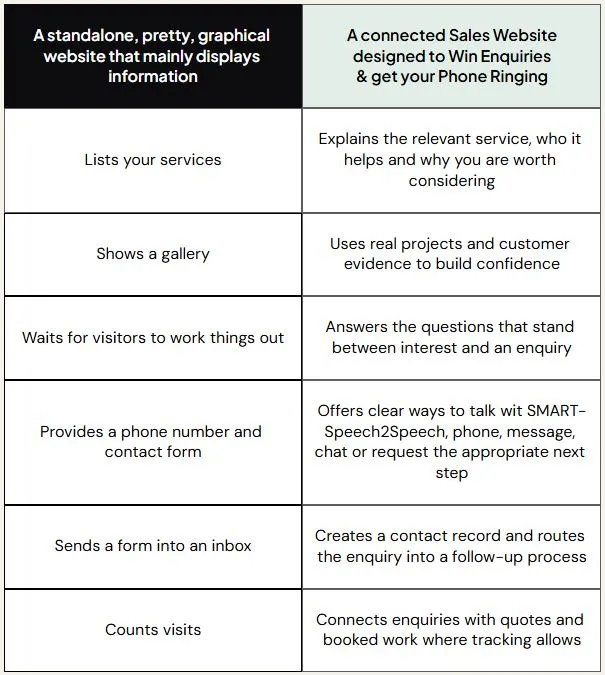
The distinction is in the job it performs.
A standalone, pretty, graphical website that mainly displays information
Lists your services
Explains the relevant service, who it helps and why you are worth considering
Shows a gallery
Uses real projects and customer evidence to build confidence
Waits for visitors to work things out
Answers the questions that stand between interest and an enquiry
Provides a phone number and contact form
Offers clear ways to talk wit SMART-Speech2Speech, phone, message, chat or request the appropriate next step
Sends a form into an inbox
Creates a contact record and routes the enquiry into a follow-up process
Counts visits
Connects enquiries with quotes and booked work where tracking allows
Built to be found. Built to persuade. Built to connect.
A functional, search-optimised sales website brings these jobs together.
Get Found:
Clear, useful pages explain your services and the areas you genuinely serve, helping customers and search engines understand the business.
Get Trusted:
Real work, customer reviews, relevant credentials and straightforward answers reduce uncertainty.
Get Chosen:
The copy gives the customer reasons to choose you, rather than expecting photographs and a logo to do all the selling.
Get Connected:
Interactive options—including chat and Smart Speach2Speach voice where configured—let people ask questions and start a conversation in a way that suits them.
Keep the conversation moving:
Contact details, enquiry history and the next action connect to your customer records and CRM, instead of disappearing into separate inboxes.
Imagine a homeowner looking at driveways in the evening. They want to know whether you cover their area, whether you handle drainage and how to arrange a quotation.
A passive page leaves them to hunt around or try again tomorrow. A properly configured interactive site can answer routine questions, collect the project details and pass the conversation into your follow-up process. Questions needing your judgement come to you with the context attached.
That's a website doing a job for the business.
The build method isn't the deciding factor. A DIY, generated or agency-built site can be developed into a capable sales tool. What matters is whether those capabilities are actually present, connected and maintained.
What works well
Capturing existing demand, strengthening trust and helping convert interest created by almost every other marketing method on this page.
Where it struggles
A website alone doesn't guarantee traffic. A good Google presence doesn't answer missed calls. Reviews don't follow up quotes. Each part needs the others.
How quickly
Better enquiry routes can help current visitors as soon as they are working. Building organic visibility and a stronger review history is a longer-term effort, often measured in months.
Who holds the relationship
Your own domain and accessible customer records give you more control. Visibility on Google still depends on Google's platform; check access and portability arrangements with any website provider.
Can you measure it
Yes: search visibility, enquiries, response times, quotes and booked work. Tracking is useful rather than perfect, particularly when people move between offline and online channels.
When spending stops
Existing pages and reviews don't vanish simply because an advertising campaign ends. But hosting, domain renewal, working connections and maintenance still need looking after.
The BUSCOO connection
Bring the website, customer conversations and follow-up together as parts of one working System.

Paid advertising
PPC and social-media advertising: pay for attention with a purpose
Paid advertising can put you in front of people without waiting for your organic presence to grow.
Search advertising can reach somebody actively looking for a service. Social advertising can introduce an idea to someone who wasn't searching—particularly when the work is visual and the transformation is easy to understand.
Both have a role. They catch people at different moments.
But buying the click is only the beginning. An advert for resin driveways should take someone to a convincing resin driveway page, with the evidence and next step they expect.
Don't pay for the introduction and then make the customer do all the chasing.
What works well
Testing a specific service, offer or area and generating traffic while longer-term marketing develops.
Where it struggles
Weak targeting, an unconvincing landing page, poor enquiry handling or spending that isn't connected to actual job results. A cheap enquiry isn't necessarily a profitable customer.
How quickly
Traffic can begin once campaigns are approved and serving. Finding a consistently profitable approach takes testing; enquiries aren't guaranteed.
Who holds the relationship
You rent access to the audience. Once someone contacts you and enters your customer records, you can build a direct relationship.
Can you measure it
Yes, particularly when campaign information follows the enquiry through to a quote and a job. Platform-reported leads alone don't tell you the full return.
When spending stops
The paid exposure stops. Existing prospects, customers and referrals can continue producing value afterwards.
The BUSCOO connection
Connect the advert, page, conversation and follow-up before increasing the budget.

Directories & platforms
Directories and trusted-trade platforms: be where customers compare
Directories and trade platforms can put you in front of customers who are already looking for help. A strong profile, relevant reviews and a recognised platform can give people reasons to make contact.
For some businesses, these channels are an important source of work.
The commercial question is whether they bring the right jobs at an acceptable cost, and whether you are building your own business on someone else's platform. Who controls the shots?
Is platform dependency really a wise choice?
What works well
Access to an existing audience and a familiar place for customers to compare providers.
Where it struggles
Competing profiles are close at hand, often your competitors are displayed to visitors, right next to your profile.
Charges, enquiry quality, visibility and control differ between providers and plans.
How quickly
Enquiries can begin after a profile becomes visible, depending on local demand and competition. Paying to appear doesn't guarantee work.
Who holds the relationship
The platform controls the discovery environment. How much of the subsequent relationship you manage directly depends on its model and terms.
Can you measure it
Yes, if you record the platform source, total cost, enquiries, quotes and completed work in your own records.
When spending stops
Paid benefits or placement may end. Whether a basic listing or reviews remain visible depends on the platform. Direct customer relationships already established may continue.
The BUSCOO connection
Treat the platform as an enquiry source and give each worthwhile enquiry a consistent follow-up process.

Bought leads
Bought leads and lead aggregators: buying an opportunity, not a job
When the diary has gaps, buying leads can look attractive. Somebody else has done the work of generating interest, and you pay for access to the enquiry.
That can be useful—especially when the service, geography and project value match what you want.
But understand what you are buying. A shared enquiry is different from an exclusive enquiry. A fresh request is different from an old record. Someone researching a possible project is different from someone ready to book.
The price of the lead tells you very little until you know the cost of the customer.
What works well
Providing another source of opportunities without having to create all the initial demand yourself.
Where it struggles
Poor fit, shared enquiries, weak intent and the time spent chasing or quoting work you don't win. Your capacity to respond matters.
How quickly
Leads can arrive quickly once supply is available. They still need qualification, a conversation and conversion.
Who holds the relationship
The supplier controls the original source. Your direct relationship develops after contact, within the terms of the service.
Can you measure it
Yes. Track purchase costs, contact rates, quotes, wins and job value. Include the time and expense of surveys and quotations when assessing profitability.
When spending stops
New purchased leads stop. Work in progress and customer relationships already won can continue.
The BUSCOO connection
Capture each lead, make the next action clear and keep a record of what actually turns into work.

A connected System
Build a connected lead-winning System
Look back at those methods.
They are different ways of starting a customer journey. None, by itself, takes responsibility for the whole journey.
The sign company supplies the sign. The publication runs the advert. The platform supplies the enquiry. The website designer delivers the pages.
Who joins it all together?
For many trade businesses, the answer is the owner—between jobs, in the van and at the kitchen table in the evening.
That's why marketing can feel like another collection of things to manage, even when the individual pieces are good.
A connected professional System gives those pieces somewhere useful to lead:
1
Get Found:
Through search, advertising, signage, referrals or existing customers.
2
Get Trusted:
Through real work, reviews, clear information and reassuring answers.
3
Get Chosen:
Give people a compelling reason to take the next step with you.
4
Get Connected:
Make it easy to call, message or chat, and capture the conversation, immediately. Not later, customers looking, want now answers
5
Get Booked:
Respond, qualify, arrange the next step and follow up the quote.
6
££ Job Done ££:
You deliver the work that earns the reputation, and get paid.
7
Get Reviewed:
Super easy invite the customer to share their experience, helping the next customer trust you. Automated polite nudges that work.
Then keep the relationship useful through relevant reminders, repeat work and referrals.
A missed call shouldn't have to be a missed opportunity
You're working. The phone rings. You can't safely answer.
That's normal in a trade business. The question is what happens next.
With Smart Text Chat configured, a missed call can start a two-way text conversation: acknowledge the enquiry, ask what the customer needs and capture useful details for your response.
It gives the customer a route forward while you're occupied—and gives you something more useful to return to than an unidentified number.
The same principle applies to website enquiries and outstanding quotes. Keep the details together. Make the next step clear. Reduce the number of opportunities depending on you remembering everything.
A website that doesn’t just show and tell. It listens and talks.
Your customer has a question. They’d rather ask it than search through pages or type into a chat box.
With Smart Speech2Speech, they can speak to your website, and it talks back, they have a sensible, coherant two way conversation about what you can, and can't, do for them. They can even book an appointment for you on your calendar.
The source of truth behind this Smart conversation, is your website content and a detailed reference, so you know the information is accurate and appropriate to your business.
A natural, two-way spoken conversation helps them explore your services, ask questions and explain what they need.
Customer behaviour has changed, they now want answers immeditaely, or they look elsewhere straightway, its' only another click and Google, Bing, AI will lead them away from you. And, calling them back at the end of the day, or weekend, no longer works, you will be throwing away valuable leads and futire jobs.
All while you’re getting on with the job.
Connected to your BUSCOO Smart System, that conversation can capture useful enquiry details and give you something meaningful to follow up.
Your website becomes more than somewhere to look. It becomes somewhere to start a conversation—and take the next step towards choosing your business.
Measure jobs, not just activity
Suppose a campaign costs £300 and produces 20 enquiries. That's £15 per enquiry.
If two become jobs, the advertising cost is £150 per booked job. If four become jobs from those same enquiries, it's £75.
This is an illustration, not a promised result. But it shows why response, trust and follow-up deserve as much attention as buying more traffic. Profitability also depends on the value and cost of delivering those jobs.
More enquiries are useful. More value from the enquiries you're already getting can be just as important.
What works well
Making existing marketing more useful, creating consistent follow-up and showing where opportunities are lost or won.
Where it struggles
A System cannot create unlimited local demand or replace good workmanship, sensible pricing and capacity to deliver. It needs accurate setup and someone responsible for the next action.
How quickly
Improvements can help new and existing enquiries once the relevant connections are working. Building reputation, repeat business and reliable performance takes time.
Who holds the relationship
Your business should have access to its customer records and a clear understanding of how data and services can be retained or moved.
Can you measure it
Yes, follow the journey from source to conversation, quote and booked job, with reasonable allowances for incomplete attribution.
When spending stops
Customer relationships and accumulated reputation can remain. Managed automation and hosted services need an ongoing arrangement or a planned handover to keep operating.
BRING IT ALL TOGETHER
Keep what works.
Connect what’s missing.
The customer side of your business, taken care of.
You don't need to abandon the methods that already bring you good work.
Keep the van. Keep the referrals. Keep the advert that earns its place.
Give them a stronger business to lead people into.
BUSCOO brings together your website, Google presence, calls, messages, reviews and follow-up, and automates as much of the admin as practical, so you miss fewer opportunities and less admin follows you home.
We build, configure and operate the System around your business, with the features and connections agreed for your service.
The customer side of your business—taken care of.
Leaving you more time to do what you're good at.

Designed and built in the UK for UK businesses.
BUSCOO
BUSCOO
Conatct Us
Useful Information
About BUSCOO
A British Business - Built To Help British Businesses
BUSCOO COMPLETE & BLACK-EDITION For Owner-Led, Micro, Small, Medium 0-49 Emplyeees <£4M Turnover
BUSCOO BESPOKE For Big Businesses >= 50 Employees>£4M Turnover

Copyright 2026. Buscoo Pro. All Rights Reserved.


